LOS ANGELES, CALIFORNIA

Building
engineering
systems from
concept to
validation.

/   MECHANICAL DESIGN & CAD /   EMBEDDED SYSTEMS & CONTROLS /   INTEGRATION & VALIDATION

A new engineer ready to learn, adapt, and contribute.

I’m an early-career Electrical Engineer who enjoys learning quickly, working across disciplines, and turning engineering problems into practical solutions.

I’m a recent Electrical Engineering graduate from the University of California, Santa Cruz, beginning my professional engineering career with hands-on experience in embedded systems, electrical hardware, controls, mechanical design, testing, and system integration.

While I’m early in my career, I’ve learned how to step into unfamiliar problems, understand what needs to be done, and adapt as a project develops. I’m comfortable learning new tools, troubleshooting when something does not work as expected, and working with teammates from different technical backgrounds.

Team projects have also taught me when to lead, when to listen, and how to take ownership of my part of a larger system. I enjoy coordinating ideas, communicating technical decisions, and helping move a project from an initial concept to a tested result.

I’m looking for an entry-level engineering role where I can contribute from day one, learn from experienced engineers, take on increasing responsibility, and continue developing into a well-rounded engineer.

01 Learn

Get up to speed quickly on new tools, systems, requirements, and technical challenges.

02 Collaborate

Work across mechanical, electrical, and embedded disciplines while communicating clearly with the team.

03 Deliver

Take ownership, troubleshoot problems, validate results, and help move the project toward a working solution.

RENEWABLE ENERGY · SYSTEM INTEGRATION PROJECT 01

UCSC SENIOR CAPSTONE

Autonomous Solar Panel Cleaning System

A multidisciplinary engineering project combining mechanical motion, embedded control, electrical systems, water delivery, and performance testing to automate residential solar-panel cleaning.

PROJECT TEAM
01
David Becerra

Mechanical Subsystem

02
Finn Murphy

Embedded Systems

03
Xezae Peshlakai

Electrical Subsystem

SYSTEM OVERVIEW UCSC · ECE CAPSTONE
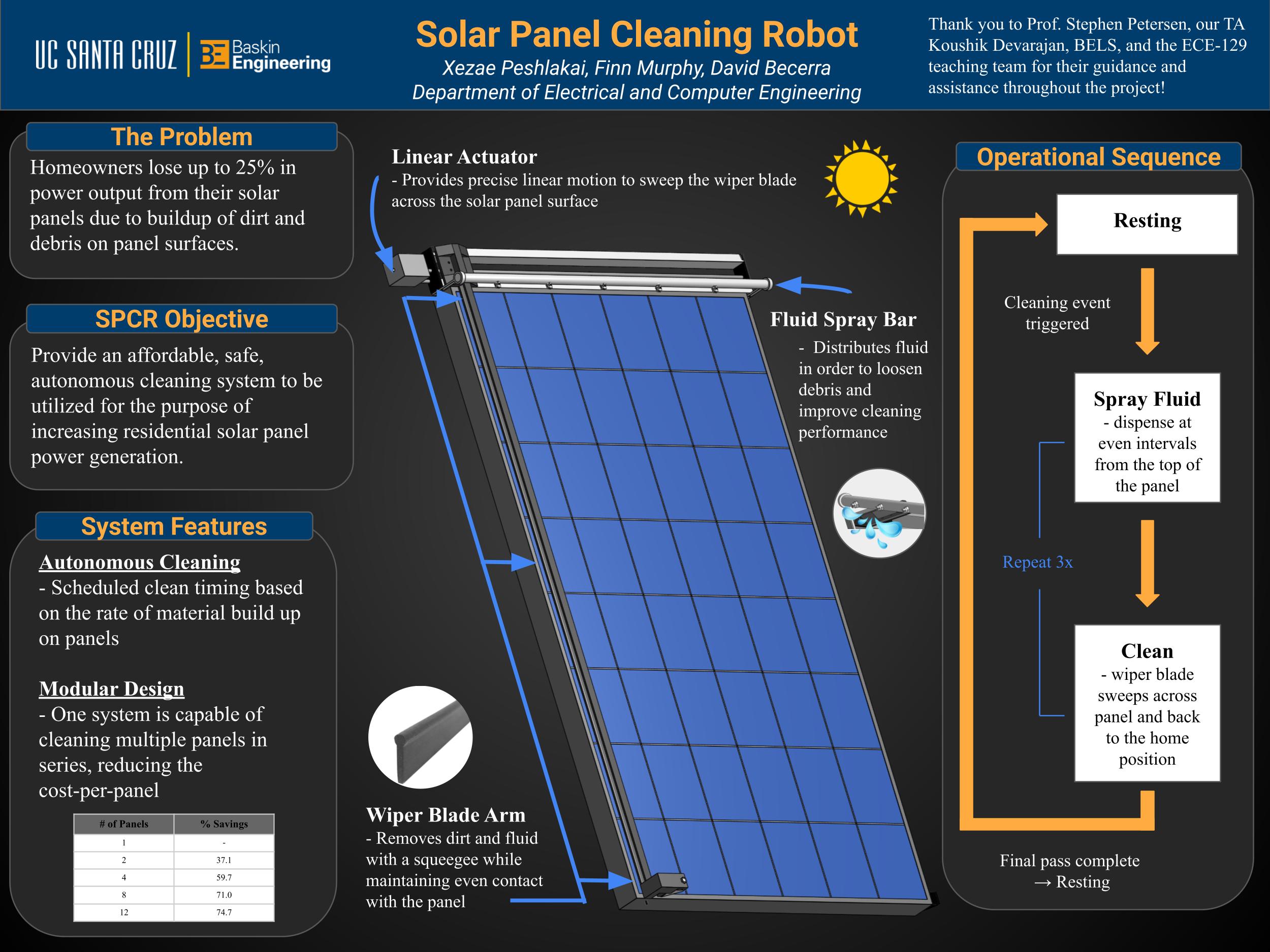
Autonomous Solar Panel Cleaning System engineering capstone poster

Residential solar panels can lose power output as dirt and debris accumulate on the panel surface. Our capstone research identified losses of up to 25% under these conditions, creating a need for a cleaning system that could maintain panel performance without repeated manual cleaning.
Design an affordable, safe, autonomous cleaning system capable of removing dirt and debris from a residential solar panel while coordinating controlled water delivery, mechanical wiping, and automated motion.

The system needed to complete repeatable cleaning cycles, return to its home position, and improve solar-panel power generation after cleaning.

I was responsible for the mechanical subsystem and led its development from concept through integration and testing.

I designed the 64-inch lead-screw cleaning mechanism, integrated the NEMA 23 stepper motor and limit switches, developed the silicone-wiper assembly, and built the water-delivery system using a 12 V pump and four-nozzle spray bar.

I also supported subsystem integration, validation testing, and project scheduling using Microsoft Project.

WORKING PROTOTYPE

System Testing

Full-system demonstration showing the cleaning mechanism operating on the solar panel.

● SYSTEM TESTING VIDEO
WATCH ON YOUTUBE ↗

SYSTEM SPECIFICATIONS

Key hardware and implementation details.

TRAVEL 64-inch lead screw
MOTION NEMA 23 stepper
PROTECTION Dual limit switches
WATER SYSTEM 12 V pump + 4 nozzles
ELECTRONICS IP67-rated enclosure
PLANNING Microsoft Project / Gantt
92% PANEL AREA COVERED
~3 cm/s CARRIAGE SPEED
~5 min COMPLETE CLEANING CYCLE
250% INCREASE IN OUTPUT DURING SEVERE-DEBRIS TESTING
EMBEDDED SYSTEMS · HUMAN INTERFACE PROJECT 02

EMBEDDED SYSTEMS PROJECT

Drawing Glove Interface

A hands-free drawing interface inspired by VR tools, translating hand movement and finger gestures into real-time cursor, drawing, eraser, and color controls.

PROJECT TEAM
01 David Becerra
02 Anuj Pongurlekar
03 Nazli Kaplanikiran
04 Filmon Gebrehiwet
WORKING PROTOTYPE EMBEDDED HUMAN INTERFACE
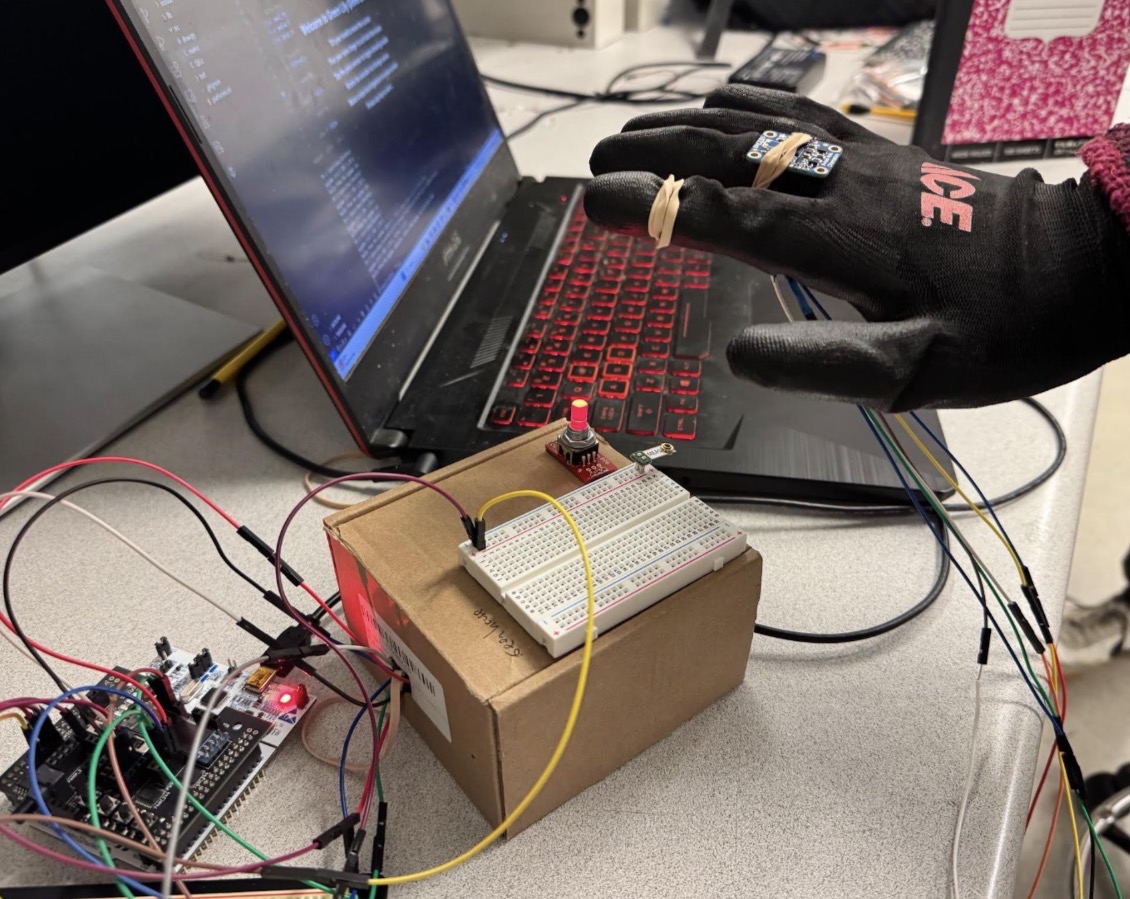
Drawing glove embedded systems prototype

Traditional computer drawing depends on a mouse, trackpad, or touchscreen. Our team wanted to explore a more natural hands-free interface inspired by drawing tools used in virtual-reality environments.

The challenge was translating several different physical hand inputs into responsive computer controls without making the interface difficult to use.

Build a wearable interface capable of controlling a live drawing canvas using hand movement and finger gestures.

Motion Tracking Use a BNO055 IMU to translate hand tilt into real-time cursor movement.
Eraser Scaling Use a flex sensor to change eraser size based on finger bending.
Mode Switching Detect tap gestures with a piezo sensor to switch between cursor and drawing modes.
Color Selection Use a rotary encoder to cycle through brush colors.

I contributed to integrating the glove’s hardware inputs with the embedded and desktop-side software needed to create the working drawing interface.

I worked with the STM32-based system and C/C++ input processing while helping connect the IMU, flex sensor, piezo sensor, and rotary encoder to the Python/Pygame drawing canvas.

I also supported system testing and refinement as the team combined the individual sensor functions into one responsive prototype.

SYSTEM ARCHITECTURE

From physical input to live canvas.

Sensor inputs are processed by the STM32 and transmitted to the desktop application where Python/Pygame updates the drawing canvas.

INPUT BNO055 IMU Flex Sensor Piezo Sensor Rotary Encoder
→
PROCESS STM32 C / C++
→
OUTPUT Serial Communication Python / Pygame Live Drawing Canvas
STM32 BNO055 IMU I²C Flex Sensor Rotary Encoder Piezo Python Pygame C / C++

WORKING PROTOTYPE

Four inputs working as one drawing tool.

The final prototype successfully combined motion tracking, mode switching, eraser scaling, and color selection into a real-time drawing interface.

● PROTOTYPE DEMONSTRATION
WATCH ON YOUTUBE ↗

Cross-disciplinary by design.

A practical engineering toolkit spanning embedded systems, electrical hardware, controls, design, prototyping, testing, and technical delivery.

01 EMBEDDED

Embedded systems & software

Build sensor-driven embedded systems and supporting desktop tools, from device-level input processing to Python-based interfaces.

CORE TOOLS
C C++ Python MATLAB STM32 PIC32 Arduino
02 ELECTRICAL

Electrical & controls

Work across circuits, power, sensing, control logic, and hardware integration to make engineering systems behave as intended.

CORE AREAS
Circuits Power Systems Controls Sensors Hardware Integration
03 DESIGN

Design & prototyping

Translate requirements into CAD, assemblies, and physical prototypes through rapid iteration and hands-on fabrication.

CORE TOOLS
AutoCAD SolidWorks Onshape 3D Printing PCB Assembly Soldering
04 VALIDATION

Test, validation & delivery

Debug, measure, document, and coordinate engineering work using structured testing, technical communication, and project planning.

CORE TOOLS
Oscilloscope Multimeter Power Supplies Debugging Microsoft Project Gantt Scheduling
04 / CONTACT
OPEN TO ENTRY-LEVEL ENGINEERING OPPORTUNITIES

Let’s build something that works.

I’m looking for an entry-level engineering role where I can contribute, learn quickly, and grow alongside experienced teams.

I’m especially interested in electrical engineering, embedded systems, hardware, controls, test, and system integration opportunities in the Los Angeles area.

If your team is building something challenging, I’d love to be part of it.